Posts tagged: guitar scale theory

Here’s a Quick Way to Understand the Major Scale on Guitar

New to my site? Don't miss a thing, subscribe to my RSS feed.

A lot of beginning guitar players don’t really know what a major scale is. Today we are going to explain exactly what scales are and what they are really used for.  Then we will look at making sense of guitar scales on the guitar fretboard.

What are Scales?

When you hear a singer sing, the notes that they sing come from a scale.

When you hear a guitar solo, the notes being played come from a scale.

The chords that accompany a singer or guitar solo come from a scale.

Just as a painter will select and mix certain colours to create a specific mood, a musician will pick certain notes or combinations of notes to create the desired affect.

Scales represent the foundation for essentially all music theory. So as you can probably guess, having a good understanding of scales and how to apply them is essential for all guitarists.

The word scale comes from the Italian word “scala”, which means ladder. A scale is simply a collection of pitches that have been arranged into a specific ascending and descending order. Scales are used as a basis for writing songs and also for soloing over chords.

Make sense? Ok, let’s take a look at the major scale…

The Major Scale

The major scale is by far the most common scale used in popular music. In order to have a major scale, there must be a specific arrangement of semitones and whole tones. A semitone is the distance of one fret on the guitar. The whole tone, also known as a tone, is the distance of two frets.

The C major scale consists of the following notes:

C D E F G A B C

Now let’s take a closer look at this scale. Let’s start by playing these notes on the 5th string.

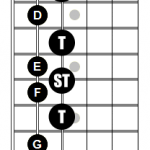
Here is the C major scale played up the fifth string:

C Major Scale up one string

The T represents a tone and the ST represents a semitone.

Now let’s take a closer look at this scale. The distance from C to D is two frets or a tone. So the distance from D to E is a tone. The distance from E to F is a semitone (one fret). The distance from F to G is a tone. The distance from G to A is a tone and the distance from A to B is also a tone. Finally, the distance from B to C is a semitone.

To recap here is what we have:

C -T- D -T- E -ST- F -T- G -T- A -T- B -ST- C

The Major Scale Formula

We now have the formula for building any major scale:

T    T    ST   T   T    T   ST

So now you can build any major scale you want. All you have to do is pick a starting note and then simply plug in the formula.

All right, so let’s put this to use. Let’s say that you want to know the notes in the D major scale.

So you start with the note D and apply the formula. This means you start with D and move up a tone. This takes you to the note E.

D -T- E

Next you need to go up a tone from the note E. Now you should recall that E to F is a semitone apart. To follow the formula you need a tone so that means that you should raise the note F by one fret. This will give you an F#.

D -T- E -T- F#

How do you know whether to call the note F# or Gb? For you to have a major scale all seven notes must be present. In other words, there must be some sort A, B, C, D, E, F, and G in the scale. Also, the notes need to be there in successive order. So you wouldn’t be able to do D E Gb, because the F is missing.

So let’s continue with the formula. So far we have done T T, so now we need our semitone:

D -T- E -T-  F# -ST- G

Next we move up a tone:

D -T- E -T- F# -ST- G -T- A

Now it’s up a tone again:

D -T- E -T- F# -ST- G -T- A -T- B

Next it is up a tone yet again:

D -T- E -T- F# -ST- G -T- A -T- B -T- C#

And finally, we move up one semitone:

D -T- E -T- F# -ST- G -T- A -T- B -T- C# -ST- D

So we now have the notes in a D major scale:

D E F# G A B C#

Let’s take a look at one more example. Let’s say you want to build a major scale off of the note F. If you apply the formula, here is your result:

F -T- G -T- A -ST- Bb -T- C -T- D -T- E -ST- F

F  G  A  Bb  C  D  E  F

As you can see there is one flat in the F major scale. How do we know that it is a Bb instead of an A#? Remember our rule: to have a major scale all seven notes must be present. There can’t be any doubled notes (except the first and last notes in the scale). So you wouldn’t be able to do F G A A#, because there would be two A’s present.

Below you will find a table of all of the major scales.

C major   C D E F G A B C

G major   G A B C D E F# G

D major   D E F# G A B C# D

A major   A B C# D E F# G# A

E major   E F# G# A B C# D# E

B major   B C# D# E F# G# A# B

F# major   F# G# A# B C# D# E# F#

C# major   C# D# E# F# G# A# B# C#

F major   F G A Bb C D E F

Bb major   Bb C D Eb F G A Bb

Eb major   Eb F G Ab Bb C D Eb

Ab major   Ab Bb C Db Eb F G Ab

Db major   Db Eb F Gb Ab Bb C Db

Gb major   Gb Ab Bb Cb Db Eb F Gb

Cb major   Cb Db Eb Fb Gb Ab Bb Cb

So there you have it. You now understand the basics of the major scale. For a quick and easy way to learn, memorize and apply the most common guitar scales, check out Guitar Essentials: Scale Master Expanded Edition.

  • Share/Bookmark

How Can I Make My Own Guitar Scales?

This is a great question that I get asked from time to time.  In this post we will look at 6 great ways to create guitar scales.

But before we get into the 6 techniques, we need to cover a bit of background…

Music has been around for a very, very long time.  Ethnomusicologists have found that music was present in even the most primitive tribal cultures. No one so far has been able to determine exactly when music began.

Different cultures use different pitch systems whereby they divide the octave differently than we do in the West.  In Western culture we divide the octave into 12 equal divisions.  This is known as equal temperament.  For comparison, it’s quite common for instruments in India to divide the octave into 22 parts.  The Slendro scale, which is common in Indonesia, divides the octave into 5 parts of which we can only accurately play the first note with our equal tempered tuning.

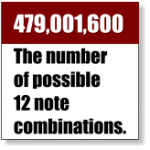
With the 12 notes we have available to us in the West, there are 479,001,600 possible arrangements!  So yes there are lots of possibilities, however, you will be pretty hard pressed to discover a guitar scale that has never been used or conceived before.

The first thing to understand about guitar scales is that a scale is simply a collection of pitches that have been arranged into a specific ascending and descending order.  Usually, the ascending and descending forms of the scale are the same, but this is not a requirement.  There are some scales where the ascending form is actually different than the descending.

Scales can have as few as 4 notes in them or can have all 12 (this is called the chromatic scale).  Seven note scales (heptatonic scales) are the most common in the West.

Here are 6 ways to create guitar scales.

First check out a good comprehensive guitar scales book such as my book, the World of Scales: A Compendium of Scales for the Modern Guitar Player.  Play through all of the scales and mark off all of the scales you like the sound of.  Once you’ve identified the scales you like, commit them to memory and start to create some melodies, guitar solos and songs.

Second you can work it out manually yourself.  This is a much longer way to go.  All you would do is grab a stack of paper and write out the notes C D E F G A B C. Next, begin to add sharps and then flats and then combinations of the two.  This method becomes more of a mathematical exercise than a musical one.  Once you’re finished, play through your results.

Another way of doing this is to just use numbers.  So you would take the scale degrees that you want, for example 1 2 3 4 5 6 7 and then you would start to add sharps and or flats.  So you could start with 1 b2 3 4 5 6 7; 1 b2 b3 4 5 6 7; etc.

Third, you can start with a chord you want to play a melody over.  You take the chord tones and write them down.  Next you experiment with the notes that are not part of the chord.  Write down the ones that you like and presto—you’ve got a scale.  Again, chances are pretty good that the scale you come up with will already have a name.

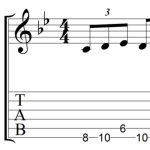
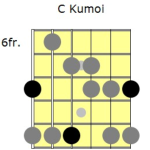
Fourth, drop out notes from an existing scale you know.  Let’s say you take a C minor scale and drop out the 4th and the 7th notes.  The result would be C D Eb G Ab C.  This creates a very cool sounding scale.  It’s a Japanese pentatonic (5 note) scale called the Hirajoshi scale.

Fifth, add in notes to an existing scale you know.  Let’s say you start with an A minor pentatonic scale: A C D E G A.  Add a B to this and you get the following 6 note (hexatonic) scale: A B C D E G A.

Finally, let’s say you are looking for a dark sounding scale.  Here’s what you do.  Start with a C major scale.  The notes in a C major scale are C D E F G A B C.

Now here’s the thing to keep in mind—as you add flats to the notes, the scale will sound darker.  As you add sharps, the scale will sound brighter.  Two scales that have a dark sound are C Db Eb F G Ab Bb C  (this is called C Phrygian) and C Db Eb F Gb Ab Bb C (this is C Locrian).

To go the opposite way to create a bright sound you take the C major scale and raise the 4th degree.  Your result is a bright sounding C Lydian :  C D E F# G A B C.

Believe it or not, this just scratches the surface of scale creation.

So you can do it on your own with 100% pure experimentation. Or, you can learn some guitar scale theory to save yourself some time and then add in some experimentation. This will give you hundreds or even thousands of guitar scales at your disposal.

Have fun!

Don J MacLean

  • Share/Bookmark

Guitar Scale Lesson: How to Read Guitar Scale Diagrams

Before we examine how to play guitar scales, we need to first look at how to read guitar scale diagrams.

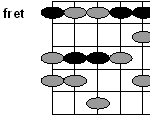
The following fretboard diagrams represent isolated sections on the neck of the guitar. The vertical lines represent the strings, while the horizontal lines represent the frets.  The strings are numbered from the thinnest (1), to the thickest (6).

To save space, only the applicable portion of the neck will be shown for each scale.  So, instead of showing all of the frets on the guitar, we will just show a representation of the portion of the neck we need.

Numbers found on the left side of the grid indicate specific frets.  If there are no numbers beside a grid, assume that it represents the first five frets.

How to read fretboard diagrams for scales

Fret-Hand Positioning

All fingerings for guitar scales and melodies using the Berklee system are based on the principle of one finger per fret.  This means that if you position your first finger on the fifth fret, the following will happen: your first finger will play all notes found on the fifth fret, your second finger will handle the sixth fret; your third finger will play notes on the seventh fret and your fourth finger will play notes on the eighth fret.  Of course these fingering principles don’t always apply to chords, but they do for scales and melodies.

In some situations you will find it necessary to have one finger play the notes on two frets.  Instead of shifting your whole hand up or down one fret, it is most practical to leave your hand in one position and have one finger cover the notes on two frets.  The finger that will do the stretching will either be your first finger or your fourth finger.  Occasionally you will encounter circumstances that will require a double stretch with your first and fourth fingers.

guitar scale fingering no stretches

No stretches

guitar scale fingering 1st finger stretch

First finger stretch

guitar scale fingering 4th finger stretch

Fourth finger stretch

guitar scale fingering double finger stretch

Double stretch, first and fourth fingers

C major guitar scale fingering

As you can see in the above fingering for the major scale, each finger is assigned a specific fret and would play any note on that fret.

C major guitar scale fingering 2

The black notes represent the root notes in the scale. The root note is the note that tells you the letter-name of the scale.  The grey notes are the other scale tones.  Other books and publications may use different symbols to indicate the location of the root notes in scales.

Scales are usually practiced from the lowest-pitched-note to the highest.  If the above scale form is positioned so that the first finger is on the 7th fret, you would have a C major scale.  Here is how you would play the C major scale.

C major guitar scale fingering 3

C major guitar scale in tab

Well, there you go.  You now know the basics of reading guitar scale diagrams.  The best way to practice guitar scales at first is to play them ascending and descending­—this will allow you to become familiar with the fingering and sound of the scale.

  • Share/Bookmark