Category: Guitar Scales

How to Add Variety to Your Guitar Solos with a Cool Japanese Minor Pentatonic Scale Part 1

New to my site? Don't miss a thing, subscribe to my RSS feed.

In today’s lesson, we will look at a cool Japanese minor pentatonic scale you can add to your guitar soloing toolkit.

This cool scale will add variety and a fresh sound to your guitar solos.

The Japanese minor pentatonic scale we will look at is called the Hirajoshi scale.

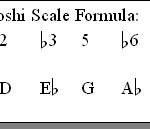
First, let’s examine its construction:

So to build this scale, you would take the major scale and lower the third and sixth notes (degrees) by one semitone each.

You also need to drop out the 4th and 7th degrees.

Let’s say you want to build an A Hirajoshi scale.

First take the A major scale:

Second, lower the 3rd and 6th scale degrees by one semitone each:

Third, you drop out the 4th and 7th degrees:


Your result is:

So, an A Hirajoshi scale consists of the following notes:

A         B            C            E            F

One other way to build this scale is to simply take the minor scale and drop out the 4th and 7th  degrees.  When you build the Hirajoshi scale from the natural minor scale, you don’t have to lower any notes.  You just need to drop out the 4th and 7th  degrees.

Since the Hirajoshi scale is simply a minor scale with the 4th and 7th notes omitted, it means you could use this scale where you normally use a natural minor scale.

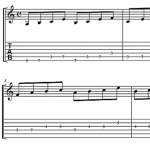
Now it’s time to take a look at one of the ways to play the A Hirajoshi scale:

Practice this scale forwards and backwards:

In part 2 of this post we will look at additional ways to practice this scale, a chord vamp that you can use to practice soloing with this scale, and we will look at creating your own solo with this scale.

  • Share/Bookmark

Guitar Scales: A Quick and Easy Way to Play Major Scales in Every Key on Guitar

In my post Here’s a Quick Way to Understand the Major Scale on Guitar, we looked at how major scales are put together.  Today we are going to look at a quick way to play the major scale in every key.  To do this we need to first look at a moveable major scale fingering.

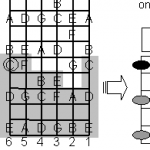
Moveable scales are as their name implies—moveable.  This means that you can take one scale shape and move it up and down the neck of the guitar to produce any desired scale.  In other words, once you learn one of the moveable shapes for a major scale, you just have to move it up or down to produce 11 different major scales.

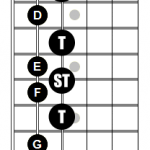
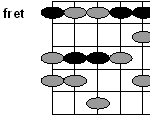
Here is how it works.  The black notes in each scale form represent the root notes.  The root note indicates the letter-name of the scale.

If we move the following 6th root major scale form so that the first finger is on the 8th fret, you will have a C major scale.

Tip: Notice that there are three root notes in the above scale form.  For this fingering, we are only concerned with the root note on the sixth string.  All you have to do is position the scale so that the root note is on the appropriate fret. The other root notes found in the scale form will automatically match up.

Now move this same scale shape so that the sixth root is on the first fret.  Since the root note is on the note F, we now have an F major scale.

See how simple that is?

This one scale form can be moved up or down the fretboard to produce any major scale that you want.

This is the big thing that is missing from most guitar scale books.

Most guitar players flip through a guitar scale book and think that there is no way that they will ever learn all of those scales.

But here’s the thing:  Most scale books will show the same scale form on different pages as if it was a different scale form.

In other words, the major scale form that you were just shown would be found in a typical scale book on one page as F major.  Then the next page would show the same scale form on the second fret and call it F# major or Gb major.  Then the next page will show the exact same fingering on the third fret and call it G major.  The problem is that most of the scale books never explain that it’s just one shape moved up and down the fretboard! This of course leads to needless confusion.

Now there are lots of other ways of play major scales.  To get good on guitar and create your own guitar solos, you will want to master these fingerings.

But guess what?

These other scale forms can be played as moveable fingerings as well.  So the best way to learn to play any type of scale, whether it be major, minor, harmonic minor, Dorian, Phrygian, etc, is to learn the appropriate set of master fingerings and then simply move the fingerings up or down the fretboard to produce any scale that you want.  It’s that simple.

If you are a beginner or intermediate guitar player and want to quickly learn these “master scale fingerings” check out–>  Guitar Essentials: Scale Master Expanded Edition.  If you are an intermediate or advancing guitarist check out -> The World of Scales: A Compendium of Scales for the Modern Guitar Player.


  • Share/Bookmark

Want Great Results When You Play Guitar? Learn Guitar Faster With A Simple Guitar Scale Tweak

One of the most important things you can do to get the most out of every guitar practice session is to keep your mental focus on the guitar. Here you will learn seven tips to keep your mind focused as you play guitar scales so you can get the results you desire.

What you focus on when you play guitar will largely determine your practice results.

If your mind is 100% focused on the guitar during your practice session, you will be able to get great results. If you are only 50% focused, well, I am sure you know what the results will be.

So, what do you do if your mind starts to wander during your practice session? Bring it back to the guitar! Focus on what you are doing.

There are many aspects of your guitar playing that you can focus on. In fact, the power of your concentration can give you remarkable results. Paying attention to the little details will allow you to make massive gains in your guitar playing.

If you have studied martial arts you may have noticed that it is the tiny details that make a difference between a black belt and white belt. A black belt and a white belt may know the same arm strike, but the black belt knows the minute details of the movement and hence can perform it at a much higher level.

The same is true of world-class musicians—when they perform a song that a novice can play, although the notes may be performed in the exact same order, the subtle details are what really brings the song to life.

So, what is the best way to keep your mental focus as you play guitar? Let us take a look at how to keep your mind focused on an area where it is easy for your mind to wander: playing guitar scales.

7 Tips to Keep Your Mind Focused as You Play Guitar Scales
Let us say you are playing guitar scales forwards and backwards and your mind starts to wander. Here are some great areas you can focus on:

1. Instead of just practicing a scale forwards and backwards, focus on the sound of each note.

2. Hear the distance (interval) between each successive note.

3. Listen to the sound quality of each note. Is every note clear? Is there a slight fret-buzz on any of the notes?

4. What about your fret-hand? How far are your fingers coming off of the fretboard after playing a note? Ideally you want to minimize wasted motion. This means that your fingers should move only the minimum distance they need to perform the passage.

The greater the distance your fret-hand fingers come off of the fretboard, the greater the distance they must return to play the next note. When you minimize wasted motion, you will be able to play guitar more efficiently and quicker.

5. Examine your pick-hand. When you play a note with a down-stroke and pick the next note with an up-stroke, how far is the pick extending beyond the string that was just played? The greater the distance a down-stoke travels beyond the picked string, the greater the distance the pick must return to perform the up-stroke.

When you perform an up-stroke, how far is the pick extended beyond the string? Again the greater the distance that the pick is extended beyond the string, the further it must return to produce a down-stroke.

The goal here is to minimize wasted motion with your pick-hand.

6. What about the muscular tension in your fret-hand? On a scale of 1-10, with 1 being minimum tension and 10 being maximum tension, how would you rate your fret-hand as you play the guitar scale? If you rate your muscular tension at 5, can you lower it to a 4, or 3? Ultimately, your goal should be a rating of 1-3. Your hands should be as relaxed as possible when you play guitar. By focusing on this you can monitor it and ultimately control it. How much tension can you detect in your forearm? Can you decrease the level of muscular tension?

7. How much muscular tension is in your pick-hand? Can you lower the level of tension without dropping the pick to the floor? What about your forearm? Is your pick-hand forearm tense or totally relaxed? Again rate it on a scale of 1-10 and then focus on lowering the rating.

This is just the tip of the iceberg for aspects you can focus on as you play guitar and guitar scales. Remember, just as with a black belt, focusing on the little things will compound into big results.

Experiment with these focus exercises and make sure you develop your own.

To learn how to make total sense of guitar scales and modes and improve your guitar playing check out the ultimate guitar scales resource. Visit the WorldofScales.com now to turbo-charge your playing with your mastery of guitar scales.

  • Share/Bookmark