Category: Guitar Chords

How to Avoid the Trap of Making Guitar Christmas Tab Songs Hard to Play

Playing Christmas songs on guitar for your friends and family can be lots and lots of fun.

Unfortunately, for the beginner or even intermediate guitarist, learning to play your favourite Christmas songs on guitar can be confusing, frustrating and time consuming.

If you’ve ever looked at any of those Christmas Songbooks you’ll know what I mean.  Within a couple of minutes of looking at one of those books, you probably got that “deer in the headlights” look.

All you see in those Christmas songbooks and sheet music are massive walls of chords, notes and complicated looking music notation.

It’s no wonder that opening a Christmas songbook is as far as most guitarists ever get when trying to learn to play Christmas songs on guitar.

Something You Must Know About Christmas Song Books and Guitar

Most of the arrangements you will find for Christmas songs were originally done for piano.

This means that the songs were arranged first and foremost for the piano.  The guitar parts were usually added in as an after thought.

In other words, once the piano arrangement for the song is complete, the arranger simply looks at the piano chords and then plops down some stock guitar chord diagrams.  This means that the guitar chord voicings or fingerings are usually not the best fingerings for guitar and more often than not, the chord progressions are made way more complicated than they need be.

Guitar vs. Piano

I’m sure you are well aware that the guitar and piano are very different instruments.  What’s important to know is certain chord progressions are very easy to play on piano.  When these easy-to-play-on-piano progressions are translated literally onto the guitar, often only an advanced guitarist can play them.

That’s right.  A lot of stuff that’s easy to play on piano is quite difficult to play on guitar.  Just so you know, the reverse is also true.  Certain guitar chord progressions that are dead easy for the beginning guitarist are very difficult for all but an advanced pianist.

The Cost of “Free” Guitar Tab Websites

Then there are the free tab websites.  I’m sure you’ve heard the expression: “You get what you paid for”.

This is often very true for a good chunk of the free tab you’ll find on the web.  Some of the free tab that’s available has been posted by beginning guitarists.

A Very Important Question About “Free” Christmas Guitar Tabs

Now let me ask you this:

“Would you want to spend your limited practice time learning an arrangement to a Christmas song that was posted online by someone who may have even less experience on guitar than you?”

Of course not!

When you set aside time for practice, you want results.  You don’t want to waste your precious practice time learning the wrong way to play a song.

Okay, by now I’m sure you’re starting to wonder:

“With all of the above stuff to worry about, is it even possible for me as a beginner to learn the Christmas songs that I want?”

Yes it is!

This is why I created 15 Easy Christmas Favourites for Guitar with Only 3 Chords.

Every year, as Christmas approaches, I have new students that want to learn a few basic Christmas songs they can play for friends and family over the holidays.

The “Catch”

These students would always say they wanted to learn to play these songs, but the catch was they didn’t want to have to take months to learn them.  After all, what’s the use of taking months to learn the Christmas songs?  You won’t get many requests for Christmas songs in the middle of July!

What I would do for these students is write out guitar arrangements for the Christmas songs that they wanted to learn.

Two Important Points…

First, these arrangements would be arranged by me, a professional guitarist, music educator and author.

Did you notice the lack of the word “piano”?

Second, these arrangements would be specifically arranged for the beginning guitarist.  What this means is I would simplify the songs down to just three chords.  This makes it really easy for beginners.  Beginning guitarists can easily learn to play three chords.

All of the arrangements I would give my students would use just three chords.  In fact, to make it even easier, all of the arrangements would use the same three chords.

Boom!

This would always make it easy for the absolute beginner to learn to play their favourite Christmas songs fast.

The other thing I would do is write out the melody in tab for each song.

Choices

Now my students would have some options.

They could learn to strum along with their favourite Christmas songs.  This would mean at Christmas time, friends and family can sing and my students can strum along.

The other thing they could do is learn to play the melody line and do a mini Christmas concert for friends and family—always lots of fun.

Some Good News for Learning Guitar Christmas Songs With or Without Tab

Up until now, you would need to have studied with me privately, or find another qualified professional guitar teacher that could write out these Christmas arrangements for you.  But now you can get your own copy of 15 Easy Christmas Favourites for Guitar with Only 3 Chords (including audio and full lyrics) and learn your favourite Christmas songs at your own pace.

Grab your copy of Guitar Christmas Tabs – 15 Easy Christmas Favourites for Guitar with Only 3 Chords now and impress your friends and family this Christmas with your guitar playing!  Remember, learning Christmas songs on guitar can be easy if you know how.  So grab your copy of The Original 15 Easy Christmas Favourites for Guitar with Only 3 Chords now and start playing the most popular Christmas songs on your guitar right now.

Guitar Lesson: Making Sense of Common Guitar Chord Symbols

Translating guitar chord symbols onto the guitar fretboard can often be frustrating and confusing.

Today we will demystify some of the most common ways that guitar chords are symbolized, so you’ll probably want to bookmark this page for future reference.

Our main focus will be on the most common guitar chords called triads.

A triad is simply a chord that contains three different notes.  These notes can be doubled, or even tripled in the chord to produce four, five, or six string chord voicings.

Chord Symbolization Rule #1

The first thing you need to understand about interpreting chord symbols is the fact that chord symbols are not standardized.  This means that you could pick up different books and sheet music and see the same chord  symbolized quite differently.  In some cases, you will find the same chord symbolized two different ways in the very same song!  In other cases, you may find inconsistencies in how chords are symbolized within the same songbook, or magazine.

The good news is that as you start to understand how chords are symbolized and begin to understand the theory behind chords, you will be able to look at a chord symbol and determine exactly what the composer, arranger, or transcriber meant.

Chord Symbolization

When chords are symbolized, the following abbreviations are frequently used:

maj → for major

min → for minor

dim → for diminished

aug → for augmented

sus 4 → for suspended 4

sus 2 → for suspended 2

Major

Often, the major chord will have no indication following its letter-name.  For example, the chords C maj, F maj and G maj, may be written as C, F, G.

Minor

Minor chords are often abbreviated as: “m”, “mi”, min, or a minus sign “—” is used.

Diminished

The diminished triad is sometimes symbolized as “dim”, “min b5”, or as “dim (triad)”.  Often the degree sign ” ° ” is used.  Bear in mind that “dim” is sometimes used to represent a diminished 7th chord.  The diminished 7th chord is also sometimes symbolized with just a degree sign ” ° “.

Augmented

The augmented chord, which is usually abbreviated as “aug”, is sometimes symbolized with a plus sign “+”.  For example, G+ and Ab+, would both be augmented triads.  You should note that the plus sign is used to represent the major chord in some texts that cover classical music theory.

Suspended

The suspended 2 and suspended 4 chords are usually just symbolized as “sus 2″, and “sus 4″ respectively.  Sometimes though, you will just see a chord symbolized as “sus” without a 2 or 4 following it.  This usually refers to the sus 4 chord.

Power Chords

One other chord symbol that you will frequently encounter as a guitar player is the symbol for a power chordPower chords are not triads.  They consist of just two different notes and are sometimes called diads or dyads.

Power chords are most commonly written as the letter-name of the chord followed by the number 5.  So a C5 is a ” C power chord”.  You will also see the power chord written with the letter-name of the chord followed by “no 3rd”, “(no 3rd)”, “(no third)”, “omit 3″, or “(omit 3)”.

Chord Symbolization Rule #2

As you can see from the discussion above, capitalization is not used consistently.  Some musicians will capitalize the “M” in major, others will not.  Some use an upper case “M” for minor chord symbolization, others do not.

Below you will see a summary of the most common ways that the basic triads  and power chords are symbolized.

Chord

Common Symbols

Major C, C ma, C Maj, C maj, C major, C Major, C+
Minor C mi, C min, C minor, C-, C m
Diminished C dim, C°, C (dim), C min b5, C° (no 7), C° (omit 7) C min b5
Augmented C+, C aug, C aug 5, C #5, C +5
Suspended 2 C sus 2
Suspended 4 C sus 4, C sus
Power Chord C5, C no 3rd, C (no 3rd), C (no third), C omit 3, or C (omit 3)

To learn more about guitar chords, and learn guitar chords fast check out Guitar Essentials: Chord Master Expanded Edition.

What are Slash Chords and How Do You Play Them on Guitar?

Have you ever seen chord symbols in sheet music like D/F# or G/B and wonder what the heck they mean?

Well in today’s post we will demystify slash chords.

First let’s look at what these chords are not.

  1. These are not chords named after the guitarist Slash from Guns and Roses fame.
  2. D/F# does not mean you can play either a D major chord or an F# major chord.

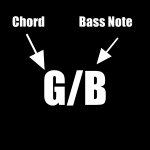
Slash chords are simply chords that are written as chord/bass note.

The bass note is the lowest sounding note in the chord.

In the G/B chord you would play a G major chord with B as the lowest-sounding note.

The D/F# chord would be played as a D major chord with F# in the bass.

The F#/C means you would play an F# major chord with a C as the bass note.

Slash chords are often used to simplify chord notation.

For example, F#/C could also be written as C7 b9 #11.

Slash chords are always written as chord/bass note.  The bass note is the lowest sounding note in the chord.

Technically, there really are two different types of slash chords.  The first kind is where a non-chord tone is the bass note.  An example of this is F#/C.  C is not part of the F# major chord.  F# major consists of the notes: F# A# C#.  As you can see, the C is not a part of the F# major chord.

The other category of slash chords is inversions.

In an inversion, the bass note is a chord tone.  In other words, you may see F#/C#.  This means you could play a voicing you know for F# major and arrange the notes so that the C# is the lowest note in the chord.

Simplifying Slash Chords

If you don’t know the notes on the guitar yet, or only know a few chords, you can simplify any slash chord by dropping out the bass note.  So in other words, when you see G/B you just play a G major chord.  If you see a D min/F, you just play D minor.

Get the idea?  It won’t sound exactly like it should, but you will still have a close runner up.

So there you go.  Now that you understand what slash chords are and how they work, you can now make sense of those songs books.  So happy strumming!

By the way, if you want to learn more about these chords and many of the other chords that will improve your guitar playing, check out my guitar chord course –> 7 Secrets to Learn any Guitar Chord Super-Fast.

In an inversion, the bass note is a chord tone. In other words, you may see F#/C#. This means you could play a voicing you know for F# major and arrange the notes so that the C# is the lowest note in the chord.