Posts tagged: Guitar Scales

5 Things You Do Not Know About Guitar Scales That You Should

Today we will look at 5 things you probably don’t know about guitar scales that you should.

Have you ever wondered why some guitar scales are called one thing in one scale book and called something completely different in another book?

What gives?  Who is right?

This brings us to the first point that most guitar players don’t know:

There is currently no standard or uniform system used throughout the world to identify scales by name. Whether you ask two musicians in the same band, or someone on a different continent, you may get completely different names for the same scale!

Some scales are pretty straight forward—they have only a few names.  For example, the Minor scale is also called the Aeolian mode or scale.  This scale is also sometimes called the Ancient Minor Scale.

Then there are those scales with many names.  For example, the Mixolydian b9 b13 scale is also known as: Phrygian Major, Phrygian Dominant, Spanish, Hejaz and it is also known as the Gypsy scale.

I am sure you will agree that this creates quite a bit of confusion when talking about guitar scales.  In fact, this brings up the next 4 things about guitar scales you probably don’t know…

How are Scales Named?

A scale can be named many different ways.  However, scale names are usually determined by:

1.  The geographical region in which the scale is typically used, or found.

2.  The geographical area one lives in.

3.  The institution(s) and or teachers with whom one has studied.

4.  The number of notes in the scale.

What is the Best Way to Understand Scale Names?

You need to learn the mechanics behind scales.  When you understand how scales are constructed and work, you will find it much easier to understand even the strangest of scale names.

When you know how scales are put together, not only will scale names make sense, but also most importantly, you will see many applications for each scale.

Scale Name Tip

Now here is a tip that will help you identify certain guitar scale synonyms.

When you look at some scale names, you will see things like b2 and b6, etc.  What you need to know is the following are interchangeable in scale names:

2 = 9

4 = 11

6 = 13

This means the Mixolydian b13 scale can also be called Mixolydian b6.  A Lydian #9 scale is also known as a Lydian #2 scale.  A Mixolydian #4 could be called Mixolydian #11.  A Locrian Natural 2 scale can be called a Locrian Natural 9 scale.

This article just scratched the surface of the mechanics behind scale names. To learn how to make total sense of guitar scales and modes and apply them to your guitar, check out the ultimate guitar scales resource. Visit  GuitarAccelerator.com now to turbo-charge your playing with your mastery of guitar scales.

How to Add Variety to Your Guitar Solos with a Cool Japanese Minor Pentatonic Scale Part 2

In my last post we began our look at the Hirajoshi scale.  Today will dig deeper into this scale…

We have already looked at the basic scale fingering for the Hirajoshi scale and how the scale is constructed.  In case you missed it, here is the link:

How to Add Variety to Your Guitar Solos with a Cool Japanese Minor Pentatonic Scale Part 1

When you first learn a new guitar scale it’s important to practice the scale forwards and backwards. This will help you to get the basic scale shape under your fingers.  Once you can play the scale ascending and descending, it’s time to work on some additional patterns to help you further master the scale.  As you learn more patterns, you’ll start to get some melodic ideas for your solos.

Let’s take a look at the Hirajoshi scale in 3 note groupings.  All you do is play the scale 3 notes at a time.

So first you play the first, second and third notes.

Then you play the second, third and fourth notes of the scale.

Next you play the third, fourth and fifth notes, etc.

Harijoshi Scale in 3 Note Groupings

Next, practice the scale in four note groupings…

Hirajoshi scale in 4 note groupings

Once you’ve worked your way through these patterns, you should start to feel comfortable with the scale.

Now you’re ready to start to improvise with the scale.

Below you will find an mp3 recording of a chord vamp that you can use to practice soloing on top of.

This vamp uses only two chords: A minor 7 and D minor 7.

You can download the simple mp3 vamp to your mp3 player and then solo away! You could also record yourself playing these two chords and then start to experiment with the scale.

Here is the download link for the mp3 track –>

Hirajoshi scale vamp mp3

(To download, just right click on the link and select “Save Target As…” or “Save Link As…”)

The first thing I would recommend that you do is play the scale forwards and backwards with the vamp playing in the background.

Here is the tab for the vamp:

Next play the scale in groups of 3 and 4 notes against the vamp.  Once you’ve done this a couple of times you will start to get the sound of the scale in your head.  This will make it easier to create guitar solos.

It’s Time to Create Your Own Guitar Solos

The best way to do this if you are new to soloing is to start really simple.

Start with a 2 or 3 note phrase.  All you do is find a combination of 2 or 3 notes that you like and create a musical phrase from them.  Once you have your phrase or motif, repeat it over the entire vamp.  Now come up with some sort of an answer to your first motif.  Again, keep it really simple—just two or three notes is all you need.

Now you will have two motifs—sort of a call and response type of thing.

Have fun with these two and start to vary them up a bit.

Change up a note or two.

Experiment with different rhythms and you are on your way to creating a cool guitar solo.

Also remember that the Hirajoshi scale is simply a natural minor scale that has its 4th and 7th notes omitted.  This means where you would normally use a natural minor scale, you have the option of using the Hirajoshi scale for some variety.

In other words, you can create a solo that’s in A minor and then for a little spice you play a melodic passage from the A Hirajoshi scale.

For more cool scales you can use to add variety to your guitar solos check out The World of Scales: A Compendium of Scales for the Modern Guitar Player.

In my last post we began our look at the Harijoshi scale. Today will dig deeper into this scale…

We have already looked at the basic scale fingering for the Harijoshi scale and how the scale is constructed. In case you missed it, here is the link:

How to Add Variety to Your Guitar Solos with a Cool Japanese Minor Pentatonic Scale Part 1

When you first learn a new scale it’s important to practice the scale forwards and backwards. This will help you to get the basic scale shape under your fingers. Once you can play the scale ascending and descending, it’s time to work on some additional patterns to help you further master the scale. As you learn more patterns, you’ll start to get some melodic ideas for your solos.

Let’s take a look at the Harijoshi scale in 3 note groupings.

All you are doing is playing the scale 3 notes at a time.

So first you play the first, second and third notes.

Then you play the second, third and fourth notes of the scale.

Next you play the third, fourth and fifth notes, etc.

Harijoshi scale in 3 note groupings

How to Add Variety to Your Guitar Solos with a Cool Japanese Minor Pentatonic Scale Part 1

In today’s lesson, we will look at a cool Japanese minor pentatonic scale you can add to your guitar soloing toolkit.

This cool scale will add variety and a fresh sound to your guitar solos.

The Japanese minor pentatonic scale we will look at is called the Hirajoshi scale.

First, let’s examine its construction:

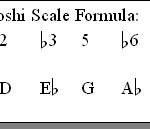
So to build this scale, you would take the major scale and lower the third and sixth notes (degrees) by one semitone each.

You also need to drop out the 4th and 7th degrees.

Let’s say you want to build an A Hirajoshi scale.

First take the A major scale:

Second, lower the 3rd and 6th scale degrees by one semitone each:

Third, you drop out the 4th and 7th degrees:


Your result is:

So, an A Hirajoshi scale consists of the following notes:

A         B            C            E            F

One other way to build this scale is to simply take the minor scale and drop out the 4th and 7th  degrees.  When you build the Hirajoshi scale from the natural minor scale, you don’t have to lower any notes.  You just need to drop out the 4th and 7th  degrees.

Since the Hirajoshi scale is simply a minor scale with the 4th and 7th notes omitted, it means you could use this scale where you normally use a natural minor scale.

Now it’s time to take a look at one of the ways to play the A Hirajoshi scale:

Practice this scale forwards and backwards:

In part 2 of this post we will look at additional ways to practice this scale, a chord vamp that you can use to practice soloing with this scale, and we will look at creating your own solo with this scale.