Category: Play Guitar

Guitar Practice Checklist: The Top 10 Things You Must Have to Not Waste Guitar Practice Time

Every guitar player wants to improve their guitar playing.  And every guitarist wants to see improvements in their playing today.

But let’s face it.  You’ve already got so much going on that it’s virtually impossible to get enough time to play as much guitar as you want.

This means for you become the best guitar player you can, you must make really good use of your limited practice time.

One of the keys to getting the most out of your practice sessions is to make sure you don’t waste any of valuable practice time.

Get Ready to Play Guitar

Before you begin your practice session, you must make sure that you are prepared to practice.  Anything that wastes practice time will diminish your results on the guitar.

So the first thing that you should do before you actually start to practice is make sure you have all of your practice materials at hand.

There’s nothing worse than starting to play guitar, and then discovering that you forgot to get some practice materials.  You now have to stop and go on a search and rescue mission for some sheet music, or something else that you wanted to work on.

Whether you’ve got 30-minutes for practice, or longer, little time wasters can add up fast.

On top of that, if it takes a while to locate what you are looking for, you may return to the guitar cold and have to do a bit of a warm-up before you can really get back into your practice session.

The Top 10 Things Every Guitar Player Should Have Ready for a Practice Session

1.  Guitar, amp, patch cords, effects pedals, power cables, adapters, CD/mp3 player. To start your practice session, you will want to have your guitar out of the case ready to play.  Also, if you need to bring out an amp and effects pedals, you will need to do so.  If this is the case you will also need the appropriate power cables and/or adapters.  If you will be playing along with some songs, then you will need your CD/mp3 player handy.

2.  Guitar picks. I always recommend having a couple of extra picks with you for your practice session.  It is quite common to put your pick down to grab something and then have a hard time finding it again.  Also, you may drop your pick and who knows where it will land.  Always have spare picks around.

3.  Electronic tuner, or tuning fork. The very first thing you need to do before you start to play guitar is tune your guitar.  So make sure you have your electronic tuner, pitch pipe, or tuning fork handy.

4.  Music stand. When you work on chords, scales, or songs from a book, you’ll find it best to prop it up on a music stand.  A music stand will allow you to look at music or a book that you are using for your practice session.  What’s most important is that music stands are adjustable so you can adjust it to the right height for you.  This will help reduce neck-strain and eye-strain.  It will also help you to sit properly so you can maximize your technique.

5.  Metronome. This essential little tool will help you develop rock-solid rhythm.

6.  A cloth for wiping down the neck of your guitar. You will want to do this before and after your practice session.  This will help prolong string life.

7.  Suitable clothing. A lot of guitarists practice in rooms that are not heated properly.  This can be a big problem.  A cold room will reduce blood flow to the fingers and arms and inhibit lubrication of tendons and joints.  A cold environment can also slow down nerve conduction.  Obviously this will negatively affect your playing.

If you don’t have the option of practicing in a well-heated room, get a small space heater or whatever is appropriate for your practice space.  If this isn’t an option, then you need to make sure that you dress warm while you practice and you may want to consider fingerless gloves to help warm your hands.

8.  Sheet music, songbooks or any guitar books you are working on. Have all of the music learning tools you will need for your current practice session ready.

9.  Guitar practice binder. A good idea is to create a guitar practice binder.  Get a big 3-ring binder.  Place dividers in it and add some blank paper.  Also add some blank manuscript paper and/or blank tab.  A good practice binder is a very useful tool.

In your practice binder you can jot down any ideas you get for practice.  Take notes about new things you want to work on, your current practice routine, etc.  In your practice binder you might want to include the scales that you want to practice, the chords you are learning or want to review, arpeggio fingerings, technique exercises, etc.

10.  A glass of water. You will probably get thirsty while you practice, but you won’t want to have to stop to go and get a glass of water, so have one handy.

Customize this list to suit your guitar practice needs. Grab a sheet of paper and write out the items from the checklist that apply to you.

Now it’s time to customize.

Write in the stuff that you are working on beside the applicable point.  Write in the current song(s) you are working.  Write down the books you are working on, etc. If you need to set up and tear down your amp every time you play, you might want to create a detailed checklist of all of the gear you need.

When you have finished your practice session, update your checklist to include what you want to work on in your next practice session. This way when you grab your practice checklist the next time, it will be current.

All you have to do is grab everything on the list.  This is great time-saver!

Place your practice checklist as the first page of your practice binder. This way it’s always easy to find your checklist.

Always return your practice stuff to the same place. When all of your guitar practice materials are in stored in the same place, it makes it easy for you to grab everything you need for your practice sessions.  This means there’s no running around trying to find stuff.

You might want to get a container or box for all of your practice stuff. This way, all you have to do is put everything you need into the box.  Then it’s really simple to get ready for your practice sessions: all you have to do is grab the box.

Also, teardown is easy too.  All you do is put everything back into the box and put it back in its place.

Are you just getting started on guitar and looking for a fast way to learn to play guitar?  Check out -> 14 Beginner Guitar Lessons.

Guitar Tutorial: One Simple Step to Avoid the Trap of Wasted Guitar Practice Sessions

It’s a common scenario…

You’ve got limited time to play guitar.

You grab your guitar and start to practice.

In a snap, your practice session is over.

The problem is you feel like you got nothing done and have nothing to show for your time.  What’s worse is, more often than not, this pattern seems to repeat itself.

Well, you’re not alone.

A lot of guitar players experience this from time to time.  Today we will look at a very common reason for wasted guitar practice sessions, and most importantly, we will look at a simple solution.

Imagine this…

A friend has decided that he’s going to compete in the next Olympics.  He invites you out to his workout/training session.

You grab a seat.  Your buddy starts to warm-up and begin to train, but about 6 minutes in, his cell phone rings…

He stops and answers the phone.  He talks for a short bit and then resumes training.

About 10 minutes later, your buddy stops again. This time it’s because he hears the “ping” notification of incoming email.  So he stops training to check his email.

What do you think of your friend’s training program?  It’s laughable to think that anyone would train this way and expect to get even half-decent results.

Now think about your guitar practice sessions.  Now I know you are not competing for the guitar Olympics, but, you do want to get the best you can from every practice session, don’t you?  Well, one of the keys to getting the most out your practice sessions is to keep your focus on the guitar and what you are doing.

The Key to Focus

To keep your focus during your practice session, you must eliminate as many potential interruptions as possible.  When you eliminate potential interruptions before you start to practice, you ensure that your practice session remains your practice time, not time that can be easily interrupted and stolen from you.

An interruption is anything that diverts your attention from what you have chosen to spend your time on.  An interruption may be someone knocking on your front door, someone calling you on the telephone, or if your computer is on all the time, it could be the little “ping” sound that says you have email.

Picture this: you are writing an important report for school or work.  You have just come up with an amazing idea, your fingers are typing as fast as they can and then out of nowhere…ring, ring, ring.  Someone is calling you on the phone.  You get up to answer the phone to find out that it was just a wrong number.  You walk back to the computer and sit down.  Now, where were you?  You read what you have written and get up to the point where you left off, and now you can’t remember where you were going to take that last idea.  Sometimes you are lucky and you can recall your idea almost immediately.  Other times it may take five, or ten minutes to get back into the flow again.  Worst-case scenario is that sometimes you can’t remember where you were going to take the idea.

As you play guitar, you will find that you will sometimes get into the “zone”.

You start to make great progress on learning that new song.

Your fingers fly effortlessly over the neck as you play that new scale, or perform that new guitar solo.

You lose track of time.

You don’t even notice that you’re hungry!

If you get interrupted, you may or may not be able to get back into the flow.  But even if you are just enjoying a normal practice session, any interruption will take you away from what you have chosen to focus your time and energy on.

Interruptions hurt your focus and steal time away from you.  When you allow an interruption to do what it does best—interrupt—you are allowing someone else to control your time. Most interruptions are random and make no consideration for your valuable time.  When the phone rings and you answer it, the caller has no idea that you actually were busy at the time they called you!  The caller steals time from you in two ways:

  1. The actual time of the interruption.  This is the amount of time it takes you to put the guitar down to answer the phone and then return to playing the guitar.
  2. Once you are playing again you have to pick up where you left off. It can sometimes take quite some time to get back into the flow of what you were doing, or sometimes you just never quite get back to where you were.

Depending on what you were doing until you were interrupted, a simple wrong number or annoying telemarketer can sometimes steal 5, 10, 15, or more minutes of valuable practice time.  If your practice session is 30 minutes and you lose 10 minutes due to an interuption─you’ve lost 1/3 of your practice time!  Don’t let this happen.  Take control of your time and eliminate as many interruptions as you can before you start your practice session.

4 Simple Ways to Avoid Interruptions When You Play Guitar

  1. If you share accommodations with others, tell them that you are not to be disturbed for the duration of your practice session.
  2. Turn off the ringer on your telephone and your cell-phone.  Let your answering system handle any calls that occur during your practice session.  If you are expecting a call, be the caller instead of the callee.
  3. Turn-off the TV and your computer.
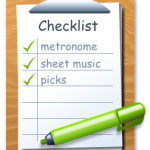
  4. Have all of your practice gear ready.  Create your own checklist of everything, and I do mean everything, that you will need for your practice sessions. This way you simply grab your checklist and then get everything you need for your practice session.  There is no messing around.  No forgotten metronome, or missing sheet music.  You’ve got what you need so you can use your practice time for practice not search and rescue missions.  Be sure to update your checklist as needed.  This is crucial!

This is just one of many ways to get the most out of your practice sessions.  To learn how to practice for maximum results, check out Guitar Accelerator.

Guitar Tutorial: The Forgotten Art of Warming Up the Right Way

Would you ever even think of doing this?

You go the gym…

You put on your workout clothes…

You load up a barbell with a huge stack of weights and then…

You just start lifting.

That’s right.  No warm-up, or anything like that.  You just jump right in and go full-out.

You would never think of doing that would you?

Of course not.

You know that’s a recipe for disaster.

But let me ask you this: “Before you start playing guitar, do you warm-up?

Most guitar players don’t warm-up at all.  They simply grab their guitar and start to play.

Well, let me ask you this:

“Are you at your best on guitar when your fingers feel cold and stiff, or are you going to play at your best when your fingers are warm, loose and limber?”

The answer is obvious.

There are many effective things you can do to properly warm-up.  There are two broad categories of warm-up: off-instrument and on-instrument.  Today we will look at the off-instrument component.

A warm-up should contain a sufficient number of exercises that will warm your body’s core temperature and allow for mental readiness and focus on the task at hand.

A warm-up will increase deep muscle temperature, increase the viscosity of joint fluids and increase the range of motion in joints.

In other words, a warm-up gets you ready to play!

The Off-Instrument Warm-up

The idea behind the off-instrument warm-up is that you warm-up your body before you even pick up the guitar.  This means you would do some very light cardio and some very light stretching.  You would do this for 2-5 minutes and then start your true practice session with your on-instrument warm-up exercises.

The light cardio can be as simple as walking or marching in place, running in place,  or jumping jacks.  The idea here is to simply warm your whole body up.

For stretching, you should perform some light stretches that will get your whole body ready for practice.  Remember that your whole body is involved when you play guitar, not just your hands.

Obviously the focus is on the hands and forearms, but other body parts are used and some will need to remain stationary for extended periods of time.  This is not easy on the supporting body parts.  This is why you want to warm them all up.  For example, think of what your neck, shoulders, and back have to do when you practice.  So it just makes sense to perform some light stretches for your neck, shoulders, back, abs, arms, hands and legs.

Here you will find a PDF you can download with 12 stretching/warm-up body exercises  – PDF.  These stretches were created for the British Association for Performing Arts Medicine.

Before you begin the light cardio and light stretching, remember it’s always best to consult with your doctor before you start any physical fitness program regardless of how light it is─just to be safe.  Don’t take any chances.  Also, if you experience any pain it’s time to stop.

So there you go, you now know the basics of how to do a simple off-instrument warm-up.  Try it out at the beginning of your next practice session and I’m sure you will notice better results from your practice time.