Category: Guitar Technique

Guitar Tutorial: 6 Simple and Effective Stretching Exercises

Finger stretches are often required for performing scales, chords and songs.

The following exercises will help promote flexibility and stretching capability in your fret-hand.

It is best to perform some warm-up alternate picking and hammer-on/pull-off exercises before you begin the stretching exercises—this means that your muscles will be warm.  The most effective stretching occurs when muscles are warm.

The stretching exercises presented here should first be performed with alternate picking.  Once you begin to find the stretches relatively easy to perform, you should then begin to play these exercises as hammer-ons and pull-offs.

The next step is to increase the actual stretch.  If the stretch is one fret, make it two frets; if the stretch is three frets, make it four frets, etc.

As you move each exercise up the fretboard it will get easier to perform the stretches because the frets get smaller.

Each of the exercises shown here begin on the first fret.  If you find the stretch very difficult to perform you can begin the exercise on the fifth, sixth or seventh frets, etc.  Also, you can decrease the required inter-finger stretch by one fret or more if required.

Remember, when you stretch you should stretch only to the point of mild discomfort and then back off a little.  Remember, stretching will not increase your flexibility if you experience any pain.

Stretching Exercise # 1

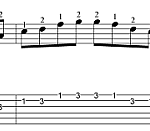
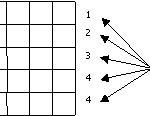
This exercise uses fingers one and two.  The stretch is one fret.  Remember to practice these exercises on each fret.

Stretching Exercise # 2

This exercise uses fingers one and three.

Stretching Exercise # 3

This exercise uses fingers one and four.

Stretching Exercise # 4

This exercise uses fingers two and three.

Stretching Exercise # 5

This exercise uses fingers two and four.

Stretching Exercise # 6

This exercise uses fingers three and four.

Want more stretching?  Check out my post -> Simple and Effective Guitar Flexibility and Finger Stretching Exercise.

For more powerful guitar technique building exercises check out my course How I Got Killer Guitar Chops While I Was Still in High School: Confessions of a High School Shredder.

Guitar Technique Tutorial: How to Perform String Skipping

Have you ever been working on a guitar song and get to a part where your pick-hand stumbles a bit?

Frequently the cause of this pick-hand stumble is because your pick-hand has to jump over two or more strings to play the next note.  This is called string skipping.

In this tutorial we look at the guitar technique string skipping.  You’ll learn what it is, how to perform it and you’ll learn some guitar technique exercises to help you master it.

String skipping simply means that you are playing notes on one string and then skip over one or more strings to play the next note.  String skipping can be quite tricky at times.  So let’s look at some exercises you can work on to master it.

Be sure to practice each exercise slowly and make sure you produce clear notes.

Generally you will find alternate picking to be the most efficient way to play passages on non-consecutive strings.  But this rule is not set in stone.  Sometimes it will make more sense to use sweep picking.  Context should be the ultimate judge.

String Skipping Exercise # 1

This exercise skips over one string and should be played ascending to the 12th fret and then backwards to the first fret.  The exercise is shown for strings 3—1, but should also be practiced with the following string groupings: 4—2; 5—3; and 6—4.

String Skipping Exercise # 2

This exercise skips over 2 strings and like exercise 1 it should be played up to the 12th fret and then played backwards to the first fret.  The exercise is shown for strings 4—1, but should also be practiced with the following string groupings: 5—2, and 6—3.

The above two exercises just used the finger combination 1-2-3-4.  You can also do string skipping exercises with different finger combinations.  For example, 1-2-4-3, 1-3-2-4, 1-3-4-2, 1-4-2-3 and 1-4-3-2, etc. can all be used with string skipping.

Performance Tip

To finish off this tutorial, I want to leave you with a tip.

When you encounter an area in a song where you frequently make errors,  you should aim to isolate and eliminate the trouble spot.

Let’s say that you are having trouble with the string skip from the fourth string to the first string in the example shown below.

What do you do?

You isolate and eliminate.

You look closer and discover the actual trouble spot in the passage:

So what you do is focus on just the trouble spot.  In other words, ignore everything else and just focus on the notes on the fourth string and the first string.

Practice these two notes:

Once you feel comfortable with this, expand out by adding in one note before the string skip.

Practice this until you’ve got it down. Then add in the next note after the string skip.

Now focus on this passage until you’ve got it down.

Next, simply repeat this process until you’ve added in the notes in the phrase before and after your string skip and bingo─you’ll have that string skip nailed down!

Are you interested in some powerful string skipping chop-building exercises?  Check out Mega Chops: Scale Mastery Beyond Hanon.

String Skipping Exercise # 2

This exercise skips over 2 strings and like exercise 1 it should be played up to the 12th fret and then played backwards to the first fret. The exercise is shown for strings 4—1, but should also be practiced with the following string groupings: 5—2, and 6—3.

Guitar Technique Lesson: How to Perform Hammer-ons and Pull-offs

Have you ever wanted to play those spine-tingling lines that sound super-smooth and oh-so fluid?

The key to playing those super-smooth, spine-tingling passages is to master hammer-ons and pull-offs.

Today we will look at how to perform hammer-ons and pull-offs and a great foundation hammer-on and pull-off exercise.

The Hammer-on

In some contexts, you will want to play notes that sound seamless and fluid.  The term for this is legato.

The best way to play notes in a legato fashion is to use hammer-ons and/or pull-offs.

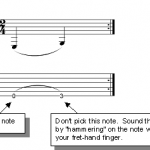
A hammer-on is produced by striking the lower pitched note and then sounding the higher note with your fret-hand finger.  You do not pick the note that is hammered.

The Pull-off

The pull-off is the opposite of the hammer-on.

To perform a pull-off you pick the higher pitched note and then sound the lower note with your fret-hand.  You “pull” your finger off of the string so that the lower pitched note is sounded.

To perform pull-offs that don’t use open strings, you will need to place the appropriate finger(s) on the notes to be sounded. Next, you pull-off the higher finger so that the lower note is heard.   You do not pick the note that is pulled off.


It is also very common to combine hammer-ons and pull-offs in a passage, so in some cases you will only pick one note and perform a combination of hammer-ons and pull-offs.

Hammer-on Pull-off Exercise

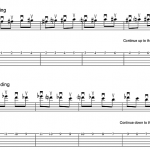
Pick the first note on each string and hammer-on the rest.  Play the descending version of the exercise by picking the first note on the string and sound the remaining notes with pull-offs.

Practice the above exercise on each fret up to the 12th fret.  Once you reach the twelfth fret play the entire exercise backwards to the first fret.

This is a great endurance exercise.  If your hands get fatigued, just play the exercise up to the 7th fret.  Every week our so, make it your goal to add one or more additional frets.

Hammer-on Pull-off Exercise # 1 XDisc 1 Track 9

Pick the first note on each string and hammer-on the rest. Play the descending version of the exercise by picking the first note on the string and sound the remaining notes with pull-offs.