Archive: September, 2010

Guitar Technique Lesson: How to Perform Hammer-ons and Pull-offs

Have you ever wanted to play those spine-tingling lines that sound super-smooth and oh-so fluid?

The key to playing those super-smooth, spine-tingling passages is to master hammer-ons and pull-offs.

Today we will look at how to perform hammer-ons and pull-offs and a great foundation hammer-on and pull-off exercise.

The Hammer-on

In some contexts, you will want to play notes that sound seamless and fluid.  The term for this is legato.

The best way to play notes in a legato fashion is to use hammer-ons and/or pull-offs.

A hammer-on is produced by striking the lower pitched note and then sounding the higher note with your fret-hand finger.  You do not pick the note that is hammered.

The Pull-off

The pull-off is the opposite of the hammer-on.

To perform a pull-off you pick the higher pitched note and then sound the lower note with your fret-hand.  You “pull” your finger off of the string so that the lower pitched note is sounded.

To perform pull-offs that don’t use open strings, you will need to place the appropriate finger(s) on the notes to be sounded. Next, you pull-off the higher finger so that the lower note is heard.   You do not pick the note that is pulled off.


It is also very common to combine hammer-ons and pull-offs in a passage, so in some cases you will only pick one note and perform a combination of hammer-ons and pull-offs.

Hammer-on Pull-off Exercise

Pick the first note on each string and hammer-on the rest.  Play the descending version of the exercise by picking the first note on the string and sound the remaining notes with pull-offs.

Practice the above exercise on each fret up to the 12th fret.  Once you reach the twelfth fret play the entire exercise backwards to the first fret.

This is a great endurance exercise.  If your hands get fatigued, just play the exercise up to the 7th fret.  Every week our so, make it your goal to add one or more additional frets.

Hammer-on Pull-off Exercise # 1 XDisc 1 Track 9

Pick the first note on each string and hammer-on the rest. Play the descending version of the exercise by picking the first note on the string and sound the remaining notes with pull-offs.

Guitar Lesson: The Basics of Alternate Picking

Alternate picking is the most common and efficient way to play notes on individual strings.

Alternate picking requires that you strike the first note with a down-stroke and the next note with an up-stroke.  The pattern is simply repeated for each successive note.

To get started with this technique we will look at a basic and very effective alternate picking exercise.

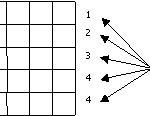
Here is how to play the alternate picking exercise shown above…

To start the exercise, begin on the first string, 1st fret.  The number combination 1-2-3-4, represents your fret-hand fingers.

Your fret-hand fingers are numbered from one to four (index to pinkie).

To play this exercise, place your first finger on the 1st fret and pick the note. Pick this note with a down-stroke.

Next, place your second finger on the 2nd fret and pick this note with an up-stroke.

Now place your third finger on the third fret and play this note with a down-stroke.

Finally, position your fourth finger on the fourth fret and pick this note with an up-stroke.

You are now ready to repeat this pattern starting on the second fret.  The exercise 1-2-3-4, should be repeated on each fret until your fourth finger reaches the twelfth fret.

You then play the exercise backwards (4-3-2-1) to the 1st fret.  This exercise should be practiced on two or more strings every time you practice. This exercise will help improve your guitar technique. It’s also a great warm-up exercise.

What are Slash Chords and How Do You Play Them on Guitar?

Have you ever seen chord symbols in sheet music like D/F# or G/B and wonder what the heck they mean?

Well in today’s post we will demystify slash chords.

First let’s look at what these chords are not.

  1. These are not chords named after the guitarist Slash from Guns and Roses fame.
  2. D/F# does not mean you can play either a D major chord or an F# major chord.

Slash chords are simply chords that are written as chord/bass note.

The bass note is the lowest sounding note in the chord.

In the G/B chord you would play a G major chord with B as the lowest-sounding note.

The D/F# chord would be played as a D major chord with F# in the bass.

The F#/C means you would play an F# major chord with a C as the bass note.

Slash chords are often used to simplify chord notation.

For example, F#/C could also be written as C7 b9 #11.

Slash chords are always written as chord/bass note.  The bass note is the lowest sounding note in the chord.

Technically, there really are two different types of slash chords.  The first kind is where a non-chord tone is the bass note.  An example of this is F#/C.  C is not part of the F# major chord.  F# major consists of the notes: F# A# C#.  As you can see, the C is not a part of the F# major chord.

The other category of slash chords is inversions.

In an inversion, the bass note is a chord tone.  In other words, you may see F#/C#.  This means you could play a voicing you know for F# major and arrange the notes so that the C# is the lowest note in the chord.

Simplifying Slash Chords

If you don’t know the notes on the guitar yet, or only know a few chords, you can simplify any slash chord by dropping out the bass note.  So in other words, when you see G/B you just play a G major chord.  If you see a D min/F, you just play D minor.

Get the idea?  It won’t sound exactly like it should, but you will still have a close runner up.

So there you go.  Now that you understand what slash chords are and how they work, you can now make sense of those songs books.  So happy strumming!

By the way, if you want to learn more about these chords and many of the other chords that will improve your guitar playing, check out my guitar chord course –> 7 Secrets to Learn any Guitar Chord Super-Fast.

In an inversion, the bass note is a chord tone. In other words, you may see F#/C#. This means you could play a voicing you know for F# major and arrange the notes so that the C# is the lowest note in the chord.